 MEIDNet
 MEIDNet Prism
Learn, build and benchmark multimodal AI for materials discovery
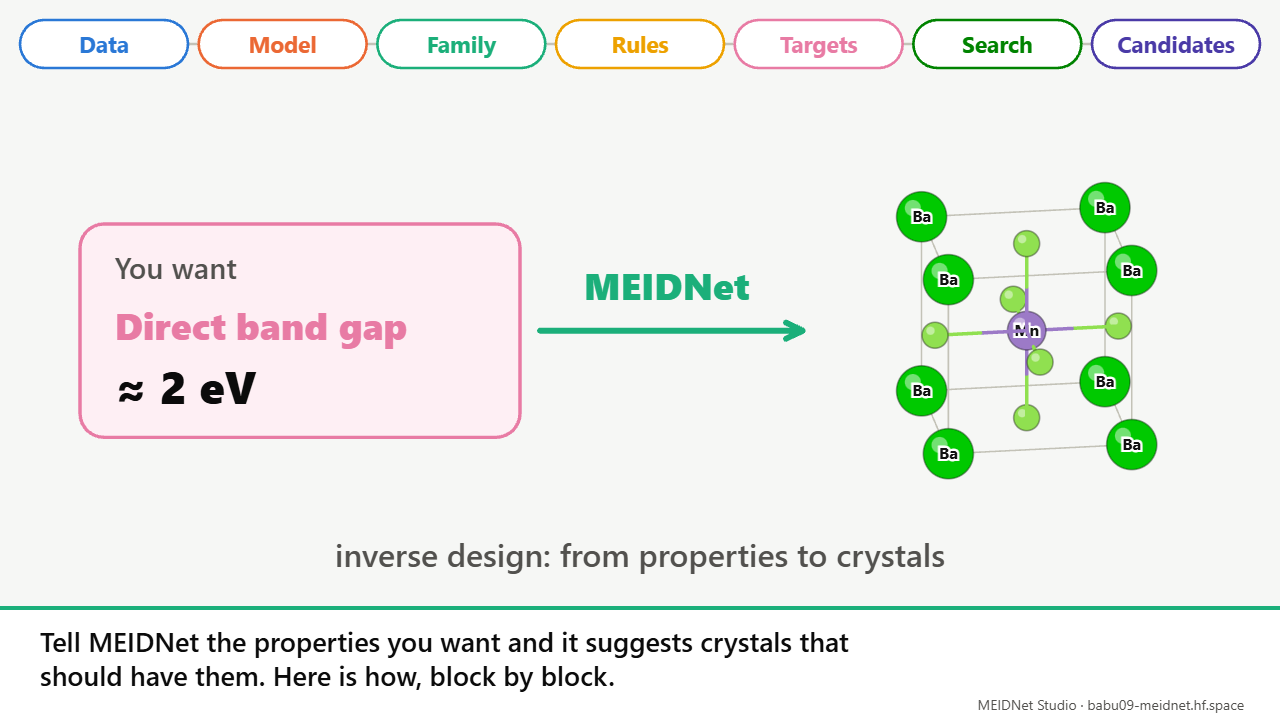
From what a modality is to a trained model and a reproducible result. MEIDNet is the reference implementation: one space shared by crystal structures and their properties, searched for new materials with the properties you want.
Published in npj Computational Materials (2026) · doi 10.1038/s41524-026-02153-3 · GitHub · MIT licence

 ▶ Play the one-minute tour
Six connected layers
Learn the ideas, pick a design, build it on your data, and show the evidence. Each layer links to the next.
1 · LearnWhat is multimodal learning?
Modalities, the five challenges of multimodal learning, contrastive learning with a playground, and an interactive map of materials modalities.
2 · ArchitecturesWhich design fits my data?
Early and late fusion, shared latent spaces, cross-attention and contrastive learning, drawn side by side, with an advisor that recommends one.
3 · BuildMEIDNet Studio
Upload structures and properties, train in the browser, set targets and rules, run the search and inspect every candidate in 3D. No code; one YAML file.
4 · DatasetsData that works
Perov-5, the published multimodal benchmark, other datasets with their status, and 31 computed and experimental databases grouped by application.
5 · BenchmarksResults with evidence
One leaderboard per dataset, an evidence ladder from “generated” to “experimentally validated”, and rows re-run here marked verified.
6 · CommunityShare and reproduce
Submit a result through GitHub. The maintainer re-runs it and marks it verified when it reproduces; a run that does not agree is shown too.
Inside Build: the MEIDNet Studio in seven blocks
The reference implementation. Change one block and the blocks after it update.
Citation
A. Babu, R. A. Gouvêa, P. Vandergheynst and G.-M. Rignanese, MEIDNet: Multimodal generative AI framework for inverse materials design, npj Computational Materials (2026). doi:10.1038/s41524-026-02153-3 · arXiv:2601.22009
@article{meidnet2026,
  title   = {MEIDNet: Multimodal generative AI framework for inverse materials design},
  author  = {Anand Babu and Rog{\'e}rio Almeida Gouv{\^e}a and Pierre Vandergheynst and Gian-Marco Rignanese},
  journal = {npj Computational Materials},
  year    = {2026},
  doi     = {10.1038/s41524-026-02153-3}
}